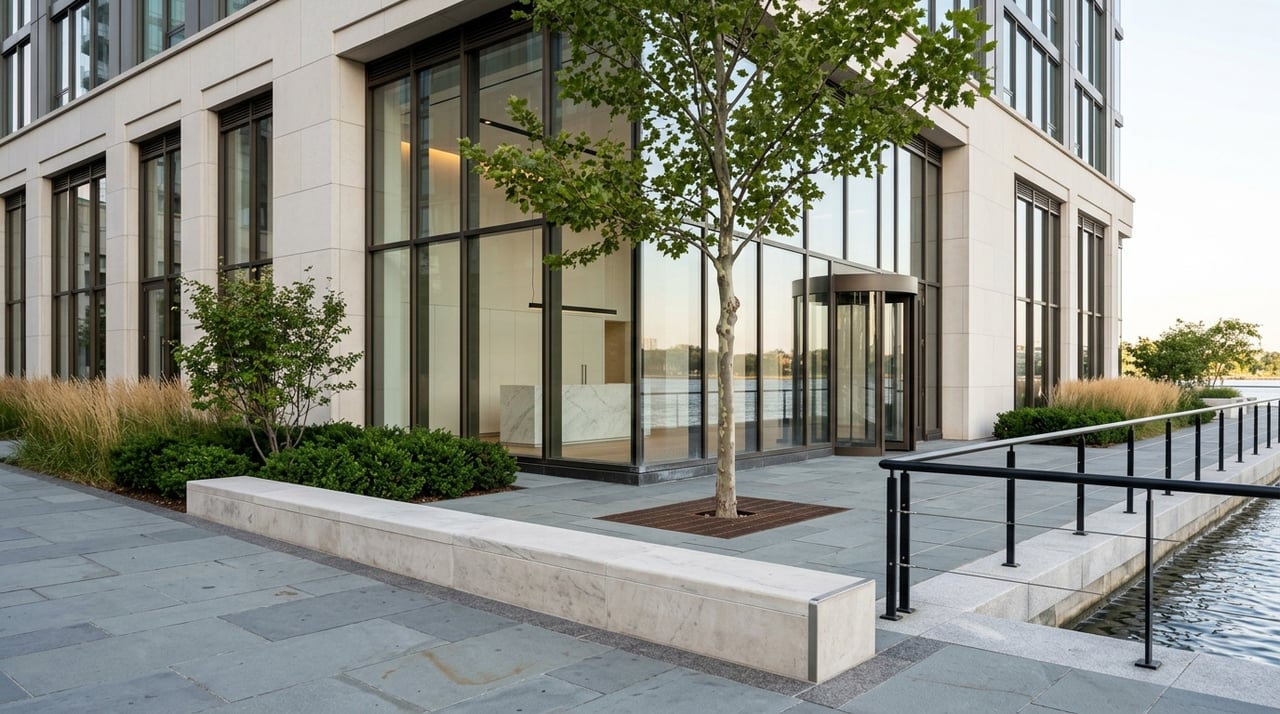
Battery Park City Waterfront Living: Is It Right for You?
June 4, 2026
June 4, 2026
Wondering whether waterfront living in Manhattan can feel both connected and calm? In Battery Park City, that is a big part of the appeal. If you are considering a move downtown, this neighborhood offers a distinct mix of river views, open space, tower living, and strong transit access. Here is what daily life on the waterfront in Battery Park City is really like.
Battery Park City is a 92-acre planned district on Manhattan’s Lower West Side, built on reclaimed land where deteriorating Hudson River piers once stood. Today, it is managed as a mix of residential, commercial, retail, and park space, with more than 13,000 residents and 36 acres of parks and open space.
That planning still shapes how the neighborhood feels. Compared with many parts of Manhattan, Battery Park City often feels more open, more park-forward, and more oriented around the waterfront than around tightly packed street life. If you value light, air, and a bit more breathing room, that difference is noticeable.
The Esplanade runs the full length of Battery Park City along the Hudson River, and it is the clearest expression of the neighborhood’s identity. For many residents, this is where the day starts or ends, whether that means a walk before work, a jog at sunset, or simply stepping outside to be near the water.
Because the Esplanade stretches through the neighborhood, it also connects everyday routines. You are not just living near the waterfront. In many ways, you are living with it as part of your normal rhythm.
One of Battery Park City’s strengths is that its park system is not one-note. Different public spaces support different kinds of daily use, which makes the neighborhood feel layered rather than repetitive.
Rockefeller Park offers large lawns, gardens, a playground, public art, and a pavilion. Teardrop Park feels more intimate and naturalistic, with rock-hopping, water play, sand boxes, a reading area, and children’s play features. Rector Park is quieter and more protected, while Belvedere Plaza above North Cove Marina hosts summer classical music programming.
If you are comparing downtown neighborhoods, this variety matters. Battery Park City is not simply a place with a river path. It is a place where open space is built into the neighborhood in multiple ways.
Battery Park City’s waterfront is also a story about resiliency. Wagner Park reopened on July 29, 2025, after major reconstruction tied to flood protection and long-term adaptation.
Its new pavilion includes a rooftop, public restrooms, public art, and space for community programming. That means the waterfront here is not just an amenity. It is also part of how the neighborhood is preparing for the future while preserving public access and daily enjoyment.
A common question about Battery Park City is whether it feels quiet. Based on its layout, open space, and waterfront orientation, the neighborhood generally feels calmer and more residential than many other parts of Manhattan.
That does not mean it feels isolated. Instead, it tends to offer a softer day-to-day pace within Lower Manhattan. For buyers and downsizers especially, that balance can be a major draw.
For everyday convenience, Brookfield Place is the neighborhood’s main retail and dining hub. The complex overlooks the Hudson River and includes more than 40 shops and services, over a dozen fast-casual options, seven restaurants, and year-round arts programming.
The Winter Garden serves as the heart of the complex, and Hudson Eats includes 14 fast-casual restaurants with Hudson views. In practical terms, this gives you an easy place for errands, casual meals, meeting friends, or spending part of a weekend close to home.
This is also important when setting expectations. Battery Park City is less defined by a dense restaurant strip and more by a mix of waterfront use, nearby services, and walkable access to retail and dining.
Battery Park City also offers strong cultural access for such a compact residential area. Nearby destinations include the Skyscraper Museum at 39 Battery Place, the Museum of Jewish Heritage at 36 Battery Place, and the 9/11 Memorial & Museum at the World Trade Center site.
The Museum of Jewish Heritage notes that it is within walking distance of One World Trade Center, the Oculus, and the 9/11 Memorial & Museum. For residents, this means culture and civic landmarks are part of the neighborhood’s everyday geography, not a separate destination trip.
If you move to Battery Park City, you are generally choosing from apartment and condo buildings rather than classic townhouse blocks or prewar co-ops. The housing stock includes older 1980s towers as well as later developments, with examples such as Gateway Plaza, Battery Pointe, Hudson Tower, Liberty House, Liberty Terrace, Liberty View, Liberty Luxe, and Millennium Tower Residences.
For many buyers, the appeal is straightforward. This is a neighborhood where tower-centric living can offer a lower-maintenance lifestyle, often with elevator access and building-level amenities that vary by property. It is best to evaluate each building on its own terms rather than assume the same service level across the board.
Battery Park City also stands out for its environmental design history. The Solaire was the first high-rise residential building in the United States to receive LEED Gold, and the Verdesian was the first condominium in New York City to earn LEED Platinum.
For buyers who care about building systems, sustainability, or the long-term value of well-conceived development, that legacy adds another layer to the neighborhood’s identity. It helps explain why Battery Park City often feels modern in both design and planning.
One of the most important ownership details in Battery Park City is the ground-lease structure. The Battery Park City Authority owns the land underneath the neighborhood, while building and condominium owners pay rent for their use of it.
If you are buying here, that means carrying costs and ground-lease terms deserve close attention. A waterfront view or strong layout may be what first catches your eye, but the financial structure behind the building matters just as much in your decision-making.
Waterfront living sometimes raises concerns about convenience, but Battery Park City is well connected. Nearby subway access includes World Trade Center on the E line, which is ADA accessible and connects to A, C, 2, 3, R, and PATH service. Other nearby stations include Rector Street on the R/W, South Ferry/Whitehall on the 1 and R/W, and Chambers Street on the 1 with 2/3 transfers.
That means you can live near the river without giving up practical mobility. For many residents, the neighborhood supports a car-light lifestyle with relative ease.
Ferry service is part of the transportation mix here, not just a leisure bonus. NYC Ferry’s St. George route serves Battery Park City at Vesey Street and connects with Wall Street/Pier 11, Brooklyn, and Midtown West. There is also Liberty Landing Ferry service between the World Financial Center and Jersey City, New Jersey.
Closer to home, the free Downtown Connection bus runs daily from 10 a.m. to 7:30 p.m. with 36 stops, roughly every 10 minutes on weekdays and every 15 minutes on weekends. The neighborhood also has M9, M20, and M22 bus stops, along with Citi Bike stations at West St & Chambers St, Vesey Pl & River Terrace, and River Ter & Warren St.
Battery Park City can appeal to several kinds of Manhattan buyers. Downsizers often appreciate the lower-maintenance feel and transit access. Pied-à-terre and investor-minded buyers may value the condo inventory, modern building stock, and easy connectivity.
It can also appeal to buyers who want a downtown location without the constant intensity they may associate with other parts of Manhattan. If your ideal home life includes open space, river walks, nearby services, and straightforward transportation, Battery Park City offers a very specific version of waterfront city living.
At its core, living on the waterfront in Battery Park City feels practical as much as scenic. Yes, the Hudson River is the visual backdrop. But the bigger day-to-day benefit is how the neighborhood turns that setting into a routine through the Esplanade, parks, nearby retail, cultural access, and transit.
For the right buyer, that combination is what sets Battery Park City apart. You get a residential environment that feels more composed and open than many Manhattan neighborhoods, while still staying deeply connected to the rest of downtown.
If you are weighing whether Battery Park City is the right fit for your next move, a building-by-building and cost-aware approach matters. To discuss the neighborhood, compare specific properties, or evaluate Battery Park City as part of a broader Manhattan search, connect with Anna Coatsworth.


Get assistance in determining the current property value, crafting a competitive offer, negotiating a sale, and much more. Contact me today.